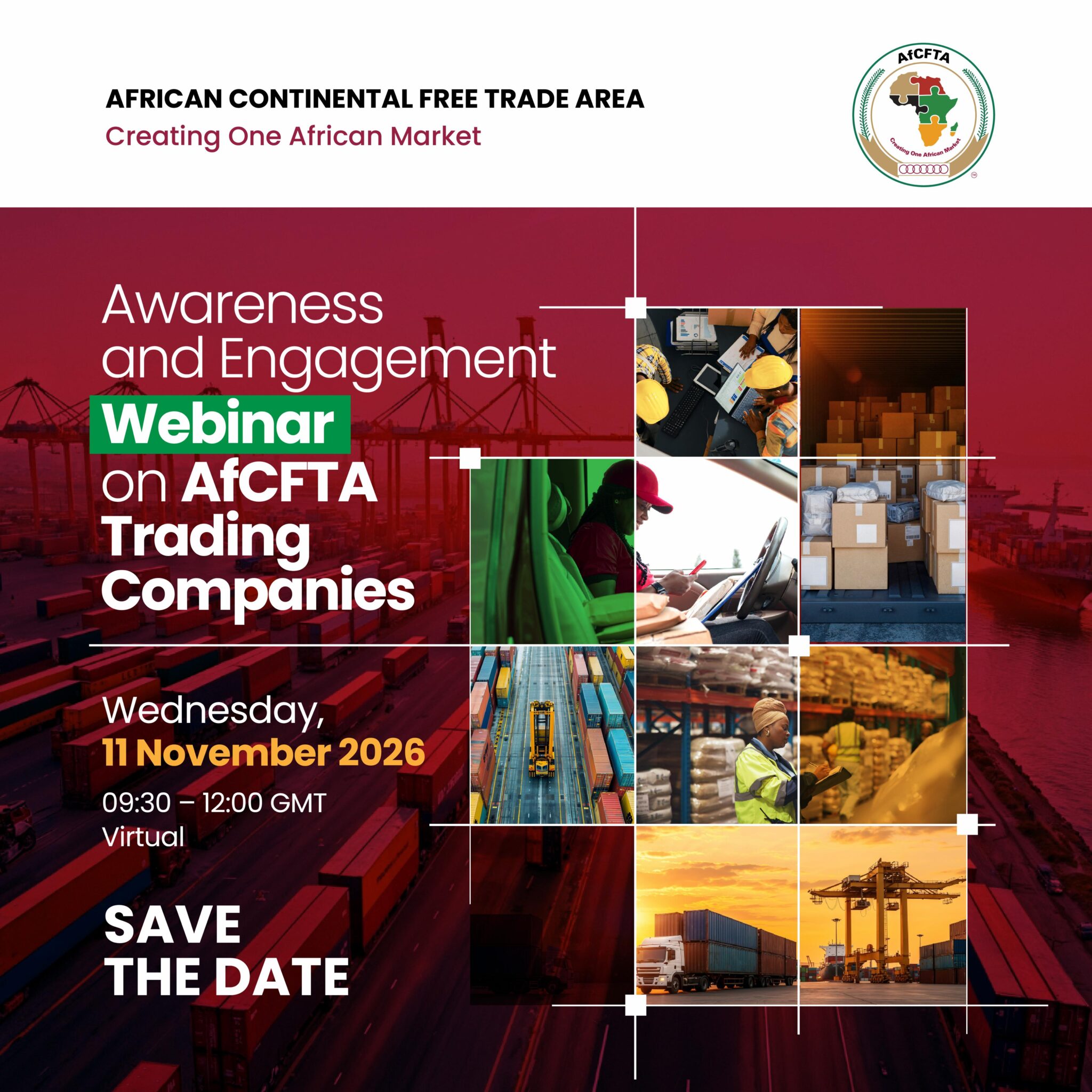
An online session convened by the AfCFTA Secretariat puts practical experience at the centre of the conversation on how businesses can make use of the single African market.
A single market only becomes real when a business uses it. The Agreement establishing the African Continental Free Trade Area (AfCFTA) entered into force on 30 May 2019. It brings together the 55 Member States of the African Union in a market of about 1.4 billion people with a combined GDP of approximately US$3.4 trillion. For a company deciding where to source, where to sell and who to partner with, the question that matters is a practical one: how does this work for my business?
That is the question at the heart of an Awareness and Engagement Webinar on AfCFTA National Trading Companies, which the AfCFTA Secretariat will convene on Wednesday 11 November 2026, from 09:30 to 12:00 GMT. The session will be held online.
Practical experience, from five active companies
The AfCFTA National Trading Companies ecosystem now includes 20 endorsed companies in 10 African countries. They are active in sectors including agro-processing, food manufacturing, logistics and industrial products. Five of them, from Chad, Egypt, Ghana, Kenya and Rwanda, will take part in the webinar and share insights from their experience of operating across African markets.
Hearing from companies that are already operating is the point of the session. Rather than describing the model in the abstract, the five Trading Companies will speak about how it works in practice.
What the session will cover
The programme addresses four questions. How does the Trading Company model work in practice? How are commercial transactions carried out across borders? Where do the opportunities lie for businesses? And how can eligible companies seek endorsement, or connect with existing Trading Companies as suppliers, buyers or partners?
The last of these matters in particular for businesses that have yet to decide how to enter other African markets. The route is open in two ways: eligible companies can seek endorsement themselves, or they can work with Trading Companies that are already in place.
Who should be in the virtual room
The webinar is particularly relevant to businesses that trade, manufacture, aggregate, warehouse or distribute goods across African borders. It is equally relevant to trade ministries, National Implementation Committees, chambers of commerce, business support organisations, export promotion agencies and other institutions that support African businesses.
How to take part
The session takes place on Wednesday 11 November 2026, from 09:30 to 12:00 GMT, online, in English, French, Arabic and Portuguese. Registration details will follow with the formal invitation.
An agreement changes the rules of trade. What turns those rules into shipments, invoices and partnerships is the work of businesses, and on 11 November five of them will describe that work in their own words.
| Terms of republication | This feature may be republished in full, free of charge, provided the byline and the source line “AfCFTA Secretariat” are kept. It is offered by the Secretariat and is not independent reporting. No photographs accompany this version: none are available before the webinar. |
| Media enquiries | Communications Division, AfCFTA Secretariat | afcftacommunications@au-afcfta.org | +233 302 986 252 |
About the AfCFTA
The African Continental Free Trade Area (AfCFTA) is one of the flagship projects of Agenda 2063: The Africa We Want, the African Union’s long-term development strategy. The Agreement establishing the AfCFTA entered into force on 30 May 2019 and brings together the 55 Member States of the African Union in a single market of about 1.4 billion people with a combined GDP of approximately US$3.4 trillion. The AfCFTA is the largest free trade area in the world by number of participating countries. The AfCFTA Secretariat, based in Accra, Ghana, and led by Secretary-General H.E. Wamkele Mene, coordinates implementation of the Agreement in cooperation with State Parties, the Regional Economic Communities and continental institutions.