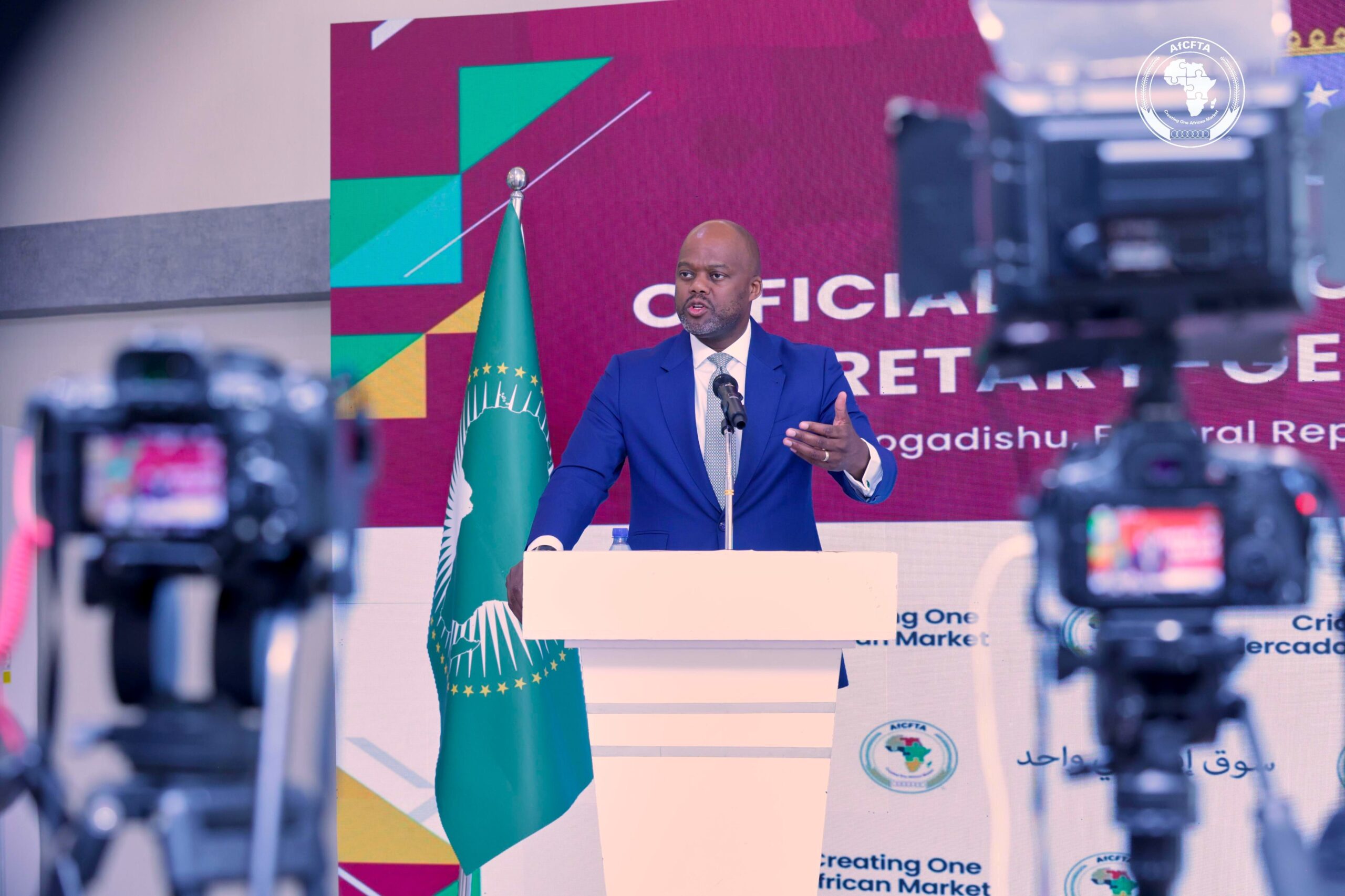
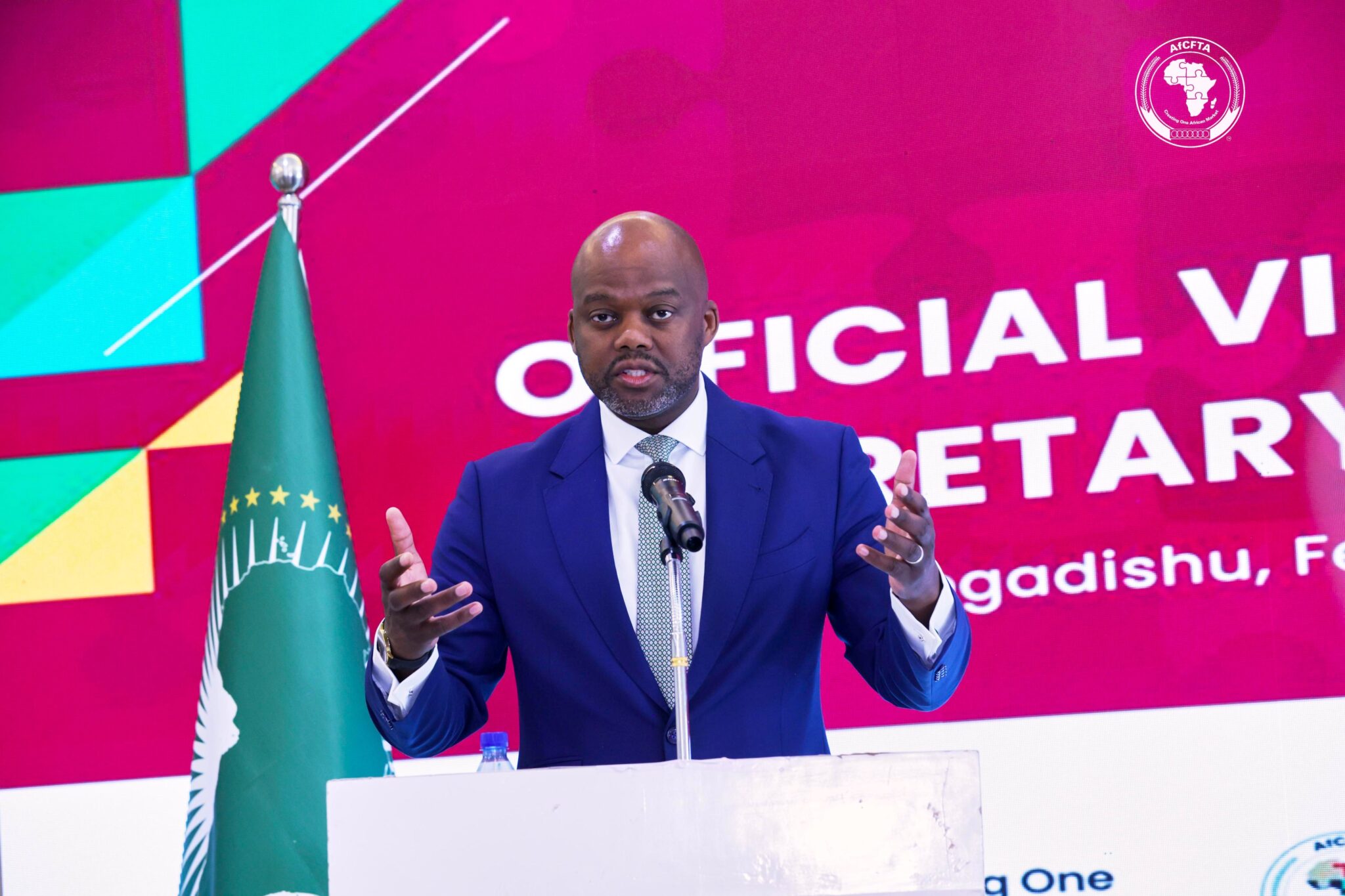
On 17 August 2026, the Secretary-General of the AfCFTA Secretariat, H.E. Wamkele Mene, spoke to Somali and international media alongside H.E. Amb. Gamal Mohamed Hassan, Minister of Commerce and Industry. He made an opening statement and then took questions. Both are set out below.
The Secretary-General spoke in English. Consecutive interpretation into Somali was provided in the room. Passages in quotation marks are offered for direct citation with the attribution given at the end of this page. Passages in plain text are the Secretariat’s rendering of the positions stated and should be reported as such rather than quoted verbatim. This page is not a transcript. Figures cited during the press point that do not appear here are being confirmed against validated sources and will be published separately.
Part one: the opening statement, in the order delivered
The Secretary-General thanked the Minister of Commerce and Industry and the Federal Government for their hospitality and for arranging the visit, and presented it as a first engagement with Somalia and explicitly not a last.
“This is the first time that we are here, and this first engagement will not be the last.”
He described the discussions of the morning as having covered areas of mutual interest in implementation.
He congratulated the Government for completing ratification with Parliament and domestic stakeholders, and described the step as a milestone for the country, for the African Union and for the AfCFTA. Somalia will be the fiftieth State Party to the Agreement establishing the African Continental Free Trade Area; the deposit of the instrument of ratification with the Chairperson of the African Union Commission is the act that confers that status.
He noted the level of intra-African trade recorded in 2024, which he described as the highest since trading under the Agreement began.
He then set out what the Secretariat seeks for Somalia, in six propositions.
That Somalia become one of the countries trading under the Agreement, with benefits sought in industrial development, job creation, regional integration and connectivity. That the country’s export profile extend, within a few years, to markets beyond the East African Community, and that its imports be drawn increasingly from the rest of the continent. That Somalia’s geography serve as a trade and transit hub for the region, supported by transport and logistics. That industrial development proceed through special economic zones fostering production and value addition within the country, in agriculture and in mineral beneficiation. That the private sector receive capacity building, including exchanges at senior officer level, in preparation for expanded trade. And, sixth, he announced the meeting with Somali enterprises for the following day, as a deep engagement to identify opportunities jointly, for export and for import.
He closed the statement on the financing of industrial development.
“Africa’s industrial development must be financed primarily, though not exclusively, by African institutions.”
He called for a joint approach to development finance partners, so that African institutions finance an African country for Africa’s own development. The qualification is part of the statement and is not to be separated from it.
Part two: the answers, by subject
The questions put by journalists were not recorded by the Secretariat and are not reproduced. The answers are presented under the subject each addressed. Any outlet holding a recording of the exchange is invited to send it to the Communications Division, which will then publish the full question and answer on this page.
On small and medium enterprises and the private sector
The Secretariat’s work with the private sector runs from the largest corporations on the continent to a small enterprise run by a young person, and includes smallholder farmers. Discussions with the Prime Minister and the Minister of Commerce and Industry had covered ways of stimulating private sector participation, including through special economic zones and centres of production excellence. A dedicated engagement with Somali enterprises was announced for the following day, to identify opportunities jointly, for export and for import.
On the sectors where Somalia already has standing
Livestock was named as the sector in which Somalia holds an established position, and as the place to begin value addition and industrial production within the country rather than exporting raw.
On Somalia’s geography
A coastline of more than three thousand kilometres and a position on the Gulf of Aden were described as connecting the Middle East and the African continent on both sides, and as lending the country a role as a trade and transit hub for the region.
On the markets Somali businesses could reach
Nigeria, Egypt and Malawi were named as markets Somali enterprises could trade with under the Agreement, within an export profile extending beyond the East African Community.
On what follows this visit
The Secretary-General said he expected the implementation process to begin from this visit. At the conclusion of the visit, the Ministry of Commerce and Industry indicated that Somalia intends to proceed with the deposit of its instrument of ratification in September 2026.