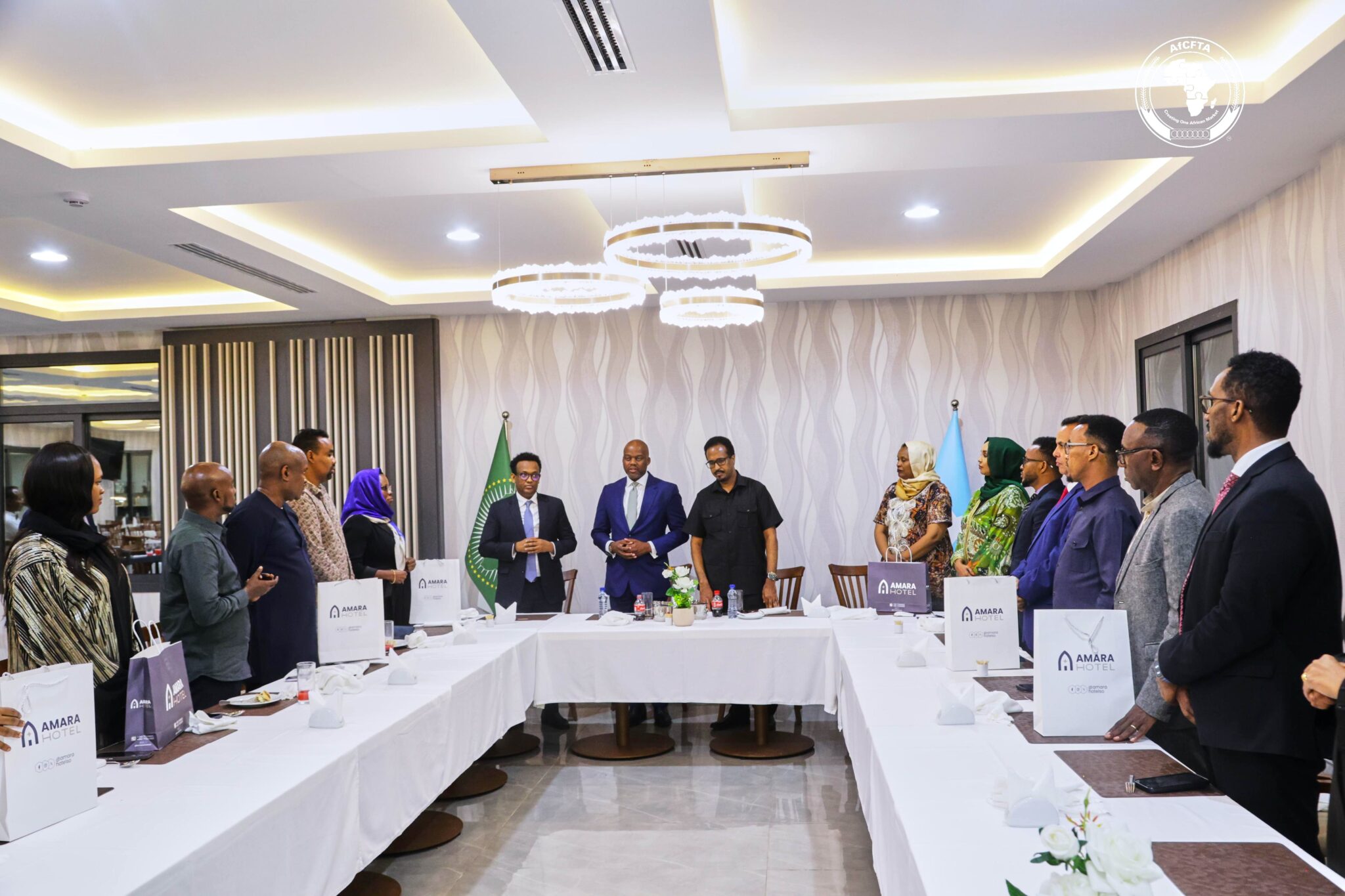
On the last day of the Secretary-General’s visit, a hotel conference room in Mogadishu filled with people who had not come to be briefed. They had come to find out how to trade.
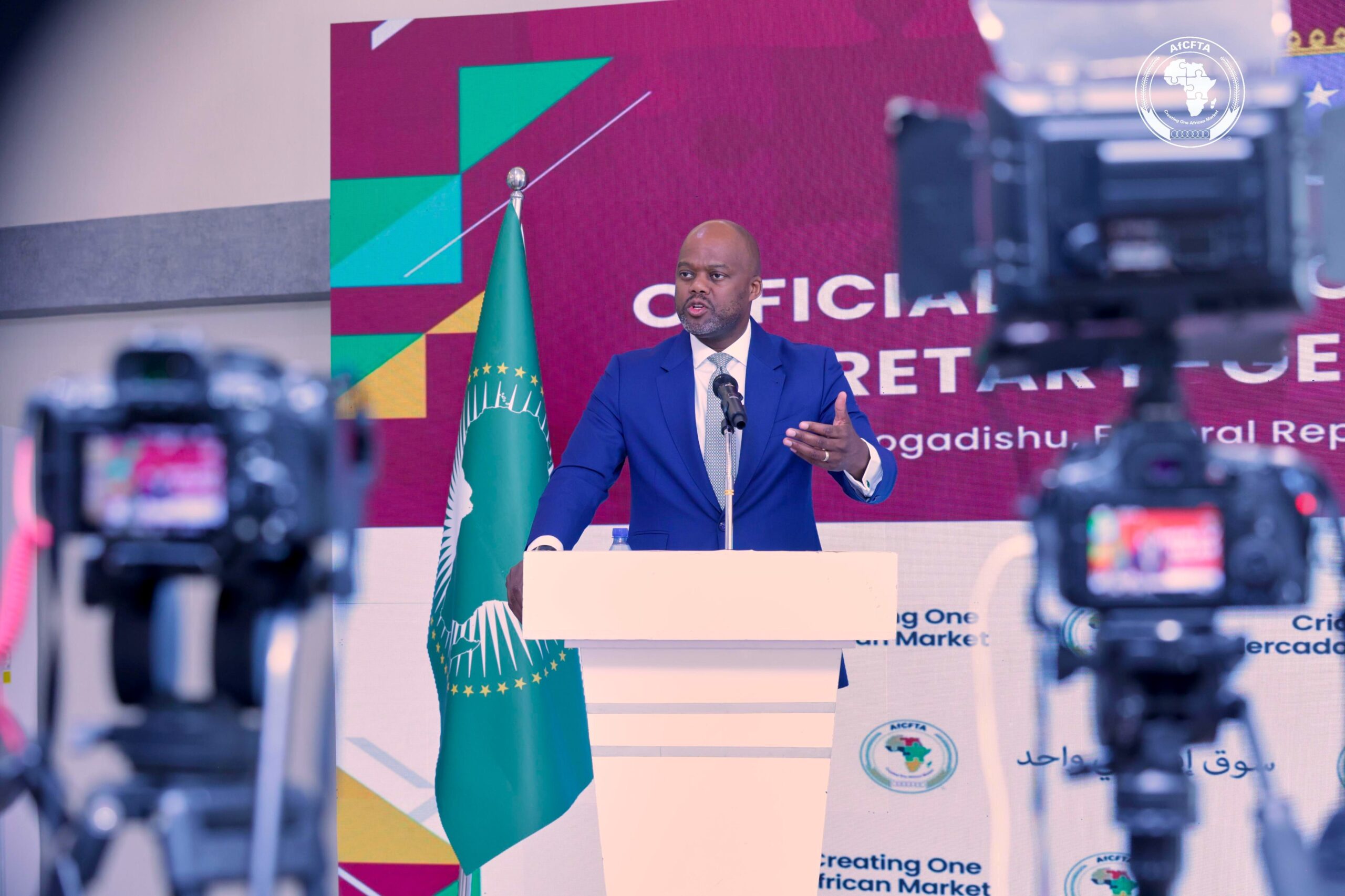
The Amara Hotel, a little after nine in the morning. The Somali Chamber of Commerce and Industry is there, and the Somali Manufacturers Association, and a row of invited enterprises, and a banker, and the head of a network of women entrepreneurs. On the other side of the table sit three officials of the AfCFTA Secretariat who have flown in from Accra.
H.E. Wamkele Mene, Secretary-General of the Secretariat, opens the session. He speaks about a market of more than 1.4 billion people that is significant and, he adds at once, very heavily fragmented, because opportunities do not arise for a private sector that stays divided. Then he tells the room what it already suspects: the delegation is leaving at 11:15 and his flight is at noon. He thanks everyone and hands back the microphone.
What happens next is the part of an official visit that is rarely photographed. The room raises its hand.
The first question is the most direct of the day, and it comes from the government side. Mr Ibrahim Noor, of the Ministry of Commerce and Industry, wants to know how soon Somalia can actually make a first shipment under the Agreement, and what businesses should be preparing for right now.
The answer, given jointly by the officials who have stayed behind, is a list rather than a promise. Somalia deposits its instrument of ratification. The AfCFTA electronic tariff book is brought into the national system. The customs administration configures the preferential tariffs, so that a preference claimed at the border is a preference actually granted. Within the East African Community, the outstanding tariff concessions and the commitments on trade in services are completed. And on the private sector’s own side, someone identifies a product whose classification in the target market genuinely permits a preference, because not every product does.
There is a reassurance buried in that list, and Mr Godfrey Walakira, Senior Trade and Competition Expert at the Secretariat, states it plainly. Somalia does not have to build a tariff offer from nothing. As a Partner State of the East African Community since March 2024, it is already covered by the Community’s consolidated schedule for the ninety per cent category. What remains is settled inside the Community, among Partner States, and not between Mogadishu and Accra.
Mr Yassine Ibar, President of the Chamber, has come prepared. He sets out five priorities in writing: guidance on the steps that follow ratification, support to priority export sectors, access to opportunities in services, a permanent channel between the Chamber and the Secretariat, and practical information on the instruments enterprises can actually use. He offers something in return, which is rarer: the Chamber will act as the bridge, identifying export-ready firms and making sure women and young entrepreneurs are among them.
Someone asks about meat. Somalia sells live animals, camels and sheep and goats, mostly northward to the Gulf. Can it sell into Africa? The answer avoids the encouraging generality. It begins with sanitary requirements and abattoir standards, because competitiveness starts with meeting what the buyer requires. It continues with the rest of the animal: hides for leather, and by-products used in pharmaceutical manufacturing, against a continental medicines import bill that is very large. And it ends with geography, because a producer standing beside a port has already removed a substantial part of the transport cost carried by a competitor shipping from Europe.
Ms Cynthia Gnassingbe-Essonam, Director of Private Sector Engagement and Communications at the Secretariat, makes the continental argument through two stories. The first is a meat counter in Accra, where she buys beef flown in from New Zealand, Australia or France, while Botswana produces excellent beef and Somalia produces camel. The demand exists; the supply is simply not organised across the continent. The second is a factory of some seven hundred people, most of them women, that stopped for three months when war began in Ukraine, because the wiring harnesses it assembled were made there, from copper that had left Zambia and the Democratic Republic of the Congo. African copper, transformed abroad, returning as a component. Seven hundred jobs interrupted by a war on another continent.
Ms Emily Njeri Mburu-Ndoria, Director of Trade in Services, takes the questions on services, which for a coastal country with a young population matter more than it usually assumes: telecommunications, logistics, finance, transport, tourism. Somalia, she confirms, is one of two countries the Secretariat is currently assisting through the process that leads from a first offer to a final schedule of commitments.
The banker asks what his sector should do on Monday morning, and is told to build trade finance products for the sectors where the country is already competitive, and to finish the technical integration into the continental payment system, because a central bank authorisation is only the first step. The head of Somali Women in Business asks for the next cohort of the export-readiness programme, not a future one. A businessman who attended the Intra-African Trade Fair in Cairo describes watching African buyers purchase, from outside the continent, goods that Africa already makes, and asks that Somali firms be in the room next time.
Then the President of the Chamber asks the question nobody usually puts out loud. Why do some countries move faster than others? The answer distinguishes ratification, which fifty countries have now completed, from the slower business of publishing a schedule in the national gazette and actually issuing certificates of origin, and it is given plainly rather than diplomatically.
Ambassador Mohamed Salem, speaking without notes, says the plainest thing of the morning. You are not only becoming part of a single continental market, he tells the businesses in front of him. You are creating jobs for the young people and the women in this room, and you are contributing to peace in your country.
At the close, the room is asked a question of its own. Three thousand five hundred years ago, ships came down from Egypt to this coast for ivory, incense and gold. Does anyone know what the Egyptians called this place? Punt. The Land of the Gods. Nothing here is being invented. Something is being resumed.
The Secretariat left Mogadishu with an undertaking: to work with Somalia towards the country’s first consignment traded under the Agreement, and to demonstrate the process from end to end rather than describe it on paper. The Ministry of Commerce and Industry has indicated that the instrument of ratification will be deposited with the Chairperson of the African Union Commission in September. Upon deposit, Somalia will be the fiftieth State Party.